
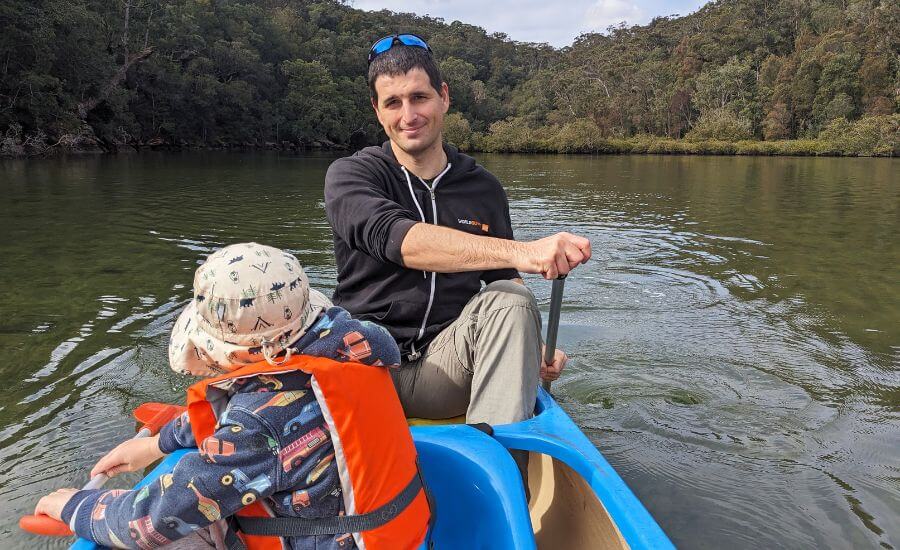
Ku-ring-gai Chase National Park is one of the best places for kayaking in Sydney — but not all launch areas feel the same once you’re on the water.
After many paddling trips here, we’ve learned that Bobbin Head and Akuna Bay offer completely different experiences, even though they’re part of the same national park. They’re not only accessed from different entrances, but the waterways behave differently with wind and tide, and the overall atmosphere easily changes from calm and family-friendly to unexpectedly challenging.
Bobbin Head was the first place we went paddling. That’s where we built confidence. Its narrow, sheltered creeks are ideal for easy paddling — preferably at high tide, when the water level is deep enough to glide easily. At low tide, some sections become very shallow and muddy, so timing matters. But in the right conditions, it’s one of the most enjoyable kayaking spots in Sydney. And not just for beginners. We still return there often to get immersed in that peaceful atmosphere and lush green bush setting.

Akuna Bay, on the other hand, taught us a valuable lesson. On one trip, we headed out under what seemed like manageable conditions — only to turn back when the wind strengthened and made progress a real struggle. The open water in the bay catches the wind quickly, and when wind and tide combine in the wrong direction, paddling becomes a battle that we can’t win (yes, the ocean is still stronger). Since then, we only go to Akuna Bay in light wind or near-still conditions.
That said, Akuna Bay is beautiful and more adventurous. The main marina area is not its only launch spot, though others are not obvious to find. With the right timing and weather, it offers long, scenic paddling routes.
So which one should you choose? It depends on your experience level, the tide, the wind forecast, and the kind of paddling day you’re looking for.

right beneath the water surface in Akuna Bay
If you’re new to paddling or looking for the most sheltered waterways in the area, you might also find my guide to 8 calm and easy kayaking spots in Sydney (perfect for beginners and families) helpful. It covers the gentlest routes across the city before you venture into more wind-affected areas like Akuna Bay.
Quick comparison: Bobbin Head vs Akuna Bay
If you’re deciding where to kayak in Ku-ring-gai Chase National Park, this overview will help you choose quickly:
| Feature | Bobbin Head | Akuna Bay |
|---|---|---|
| Best For | Beginners, families, relaxed paddling | Confident paddlers, longer routes |
| Water Type | Narrow creeks (Cockle Creek & Cowan Creek) | Wide open bay connected to Cowan Creek |
| Wind Exposure | Low to moderate | High – very wind affected |
| Tidal Impact | Shallow at low tide | Strong current in places |
| Powerboat Traffic | Not allowed on Cockle Creek, moderate on Cowan Creek | Marina traffic in bay area |
| Launch Spots | Clearly marked canoe launch | Several spots, not all obvious |
| Difficulty | ⭐ Easy (with tide planning) | ⭐⭐ Moderate (weather dependent) |
| Best Conditions | High tide + light wind | Slack tide + very light wind |
If you’re new to kayaking or paddling with kids, Bobbin Head is usually the safer and more forgiving choice. If you’re comfortable managing wind and tidal flow, Akuna Bay offers a bigger-water experience.
What makes Ku-ring-gai Chase National Park one of the best paddling destinations in Sydney?

It’s easily reachable from the city (granted, mostly easily if you live on the North Shore), and it has:
- Sheltered tidal creeks
- Scenic bushland
- Accessible launch points
- Family-friendly picnic areas
Both Bobbin Head and Akuna Bay sit along the Cowan Creek water system, which means tides affect water levels and current in both areas. But you’re still far enough from the open sea to find many sheltered paddling routes.
I can’t get bored of the scenery. It’s untouched bushland, with occasional bird song and wallaby sightings, and it’s easy to forget you’re still in Sydney.

We spot wildlife almost every time we paddle here. Herons and cormorants are regular companions along the banks, and if we’re lucky, a sea eagle circles overhead. In the more sheltered bays, hundreds of jellyfish sometimes drift together in slow-moving clusters — fascinating to observe from the safety of a canoe. And in the shallow sections, stingrays often glide just beneath the surface —they favour shallow bays with sandy bottoms.

Oh, and we don’t merely go to Ku-ring-gai Chase for paddling. It’s also one of Sydney’s most scenic bushwalking destinations, and we take full advantage of living so close to it. If you’d like to combine paddling with a short hike or lookout walk, here are the best walks in Ku-ring-gai Chase National Park to add to your day.
Before heading out for a paddle, it’s worth:
- Checking tide times
- Checking wind speed and direction
- Paying the vehicle entry fee (or using an NSW National Parks annual pass)
Now let’s see the details about Bobbin Head and Akuna Bay.
Bobbin Head kayaking

Why Bobbin Head is ideal for beginners
Bobbin Head is the more sheltered and beginner-friendly paddling area in Ku-ring-gai Chase National Park.
From the clearly marked canoe launch area, you can explore:
- Cockle Creek (no powerboats allowed)
- Cowan Creek (wider but still relatively calm)
The narrow waterways and surrounding bushland provide natural wind protection, making it much easier to manage in light breeze conditions. But actually, the three main directions you can choose are all a bit different, allowing you to gradually choose a bit less sheltered route each time you feel ready for it — see them marked on the map below, with three different colors:
Cockle Creek paddle route – the easiest kayaking option at Bobbin Head (best at high tide)
If you’re looking for the most beginner-friendly kayaking route at Bobbin Head, start with Cockle Creek.

Launching from the Bobbin Head canoe launch area, you’ll enter a narrow, sheltered waterway where the water is calm and often very shallow. In fact, at low tide you can often touch the sandy bottom with your paddle. We’ve learned the hard way that paddling this route at low tide means turning back early — or getting stuck in the mud.
For the best experience, plan this route at mid-tide or high tide. When water levels are high enough, we can glide smoothly over the sandbanks and explore the full length of the creek without constantly navigating around shallow patches.
The navigable route on Cockle Creek is quite short, anyway. The main route is approximately 1.8 km one-way, with an optional 500-metre side branch that’s only accessible when water levels are high enough.

It’s not a long paddle, which makes it perfect for families, first-time kayakers, or anyone wanting a relaxed outing in Ku-ring-gai Chase National Park. You can combine it with a BBQ lunch or a short bushwalk. Bobbin Head also has one of the best nature playgrounds in Sydney.
One of the biggest advantages of Cockle Creek is that powered boats are not allowed. Combined with the narrow, naturally protected channel, this keeps the water surface calm and peaceful. Even on breezier days, the surrounding bushland provides shelter, making conditions much more manageable than in more open areas.
As you paddle upstream, you’re surrounded by eucalyptus forest and striking orange-yellow sandstone cliffs. The scenery feels surprisingly wild considering how accessible the launch area is.
For beginners wanting a safe and scenic introduction to kayaking in Ku-ring-gai Chase National Park, Cockle Creek is hard to beat.
Cowan Creek inland paddle – a sheltered, scenic route for families

From the same Bobbin Head canoe launch, you can head in the opposite direction towards Cowan Creek. After paddling under the bridge, you’ll notice the waterway opens up, offering longer (and also less sheltered) routes.
For the more sheltered option, turn right after the bridge and paddle upstream, passing Empire Marina. As you continue inland, Cowan Creek gradually narrows and becomes calmer again, creating a peaceful corridor framed by mangroves and eucalyptus woodland.
This is one of the most enjoyable family-friendly kayaking routes in Ku-ring-gai Chase National Park, and we return here very often.

The length of this paddle depends heavily on the tide though. At low tide, shallow sections limit how far you can go, and the route becomes noticeably shorter. Mid-tide and high tide are ideal if you’d like to explore further upstream. With more water beneath you, it’s a relaxed and scenic glide.
We’ve paddled this route more times than we can count. On a good tide, we can usually cover around 5 km one-way before reaching a narrowing section with several submerged rocks that naturally mark a turnaround point.
Wildlife spotting is excellent here, even better than on Cockle Creek. Herons, cormorants and other waterbirds are common along the mangroves, and the quieter upper reaches feel surprisingly remote.
Compared to Cockle Creek, this route is slightly more exposed, but it remains far more sheltered than paddling towards Apple Tree Bay. It strikes a nice balance: longer and more varied than Cockle Creek, yet still calm and manageable for beginners.
When we want a relaxed, scenic paddle at Bobbin Head — something longer than the short creek loop but without venturing into open water — this is usually the route we choose. On a still day, the reflections of the forest in the calm water make it especially beautiful.
Cowan Creek to Apple Tree Bay – for confident beginners

If you turn left after paddling under the bridge at Bobbin Head and head towards Apple Tree Bay, you’ll quickly notice the difference. This is the most challenging kayaking route from the Bobbin Head canoe launch — and where you truly experience paddling on a tidal river.
As Cowan Creek widens, the natural shelter decreases. The tidal current becomes more noticeable, and the water feels more dynamic than on Cockle Creek or the inland Cowan Creek route.
The river level rises and falls twice a day, and the direction of the current changes with the tide. Unlike the previous two routes, paddling against the flow can require real effort — especially if wind and tide oppose each other.
Because the creek is wider in this direction, wind also has a greater impact. Even moderate breezes can create choppier surface conditions. For the most enjoyable and safest experience, it’s important to check both tide times and wind forecast before heading out.

Ideally:
- Paddle with the tide rather than against it
- Avoid strong wind forecasts
- Plan your turnaround point in advance
That said, if timing isn’t perfect, it’s still possible to paddle against the current for a while — we’ve done it several times — it just becomes more physically demanding.
The furthest we’ve paddled in this direction is 5.3 km one-way before turning back, making it roughly a 10 km return trip. There’s no fixed end point; you can continue as far as conditions, energy levels and tide allow. Some paddlers plan to turn around as the tide changes direction, but that requires careful timing.
Unlike Cockle Creek, boats are allowed on Cowan Creek. However, upstream sections past Empire Marina tend to see very little traffic due to shallow water. As you paddle towards Apple Tree Bay, boat activity becomes more common, so we usually stay close to the shoreline for visibility and safety. In our experience, most boat operators are respectful and mindful of kayakers.
For confident beginners who are comfortable managing tidal flow and light boat traffic, this route offers a rewarding step up from the sheltered creeks. It combines scenic bushland views with a more dynamic paddling experience. And it’s a good introduction to open tidal waterways before venturing somewhere like Akuna Bay.
Which Bobbin Head route should you choose?

Choose Cockle Creek if:
- You’re a first-time kayaker
- You’re paddling with young children
- You want calm, narrow waterways
- It’s mid-to-high tide
- You prefer no powerboat traffic
This is the easiest and most sheltered option.
Choose Cowan Creek (inland route) if:
- You want a longer but still relaxed paddle
- You enjoy wildlife spotting and mangroves
- You’re comfortable with mild tidal influence
- It’s mid or high tide
This is the best balance of distance and shelter.

Choose Cowan Creek to Apple Tree Bay and further if:
- You’re a confident beginner
- You’re comfortable managing tidal current
- The wind forecast is light
- You want a longer, more open-water experience
This is the most demanding route from Bobbin Head.
Pros of kayaking at Bobbin Head
- Very sheltered creeks
- No powerboats on Cockle Creek
- Short, manageable routes
- Family-friendly facilities (playground, picnic areas, toilets)
Cons of Bobbin Head
- Too shallow at low tide in narrow sections
- Very popular on sunny weekends
Akuna Bay kayaking

What makes Akuna Bay different
Akuna Bay feels very different from Bobbin Head. Technically, you’re still within the Cowan Creek system, but instead of paddling along a narrow, sheltered creek, you’re crossing a wide open bay that connects to the broader stretches of Cowan Creek. The sense of space is much greater — and so is the exposure.
There’s a large marina with yachts, more open water, and noticeably more boat traffic. Natural wind protection is limited compared to the narrow creeks around Bobbin Head. On calm days, the bay can be stunningly beautiful, with expansive bushland views. But it requires far more planning and awareness of conditions.
We learned that the practical way. On one trip, what started as manageable conditions quickly changed as the wind picked up. The open water caught the breeze, small waves began slapping against the canoe, and forward progress turned into a steady effort. Eventually, we decided to turn back. It wasn’t unsafe — but it was no longer enjoyable. (I do mind being splashed in the face.)
Akuna Bay reacts quickly to wind. Even moderate forecasts can create choppy, splashy conditions, especially when wind and tide oppose each other. Some paddlers enjoy that challenge. We didn’t find it ideal for relaxed family outings — and we prefer to stay dry.
Lesson learned: only paddle Akuna Bay in light wind or near-still conditions.
Choose your timing carefully, and it can be a rewarding, scenic kayaking experience in Ku-ring-gai Chase National Park. Choose poorly, and it becomes hard work.
Best conditions for kayaking at Akuna Bay
Wind:
- Under 10–15 km/h
- Early morning is best
Tide:
- Paddle near slack tide (around high or low tide change)
- Avoid peak flow (midway between tides)
- Plan to go with the current if possible
Akuna Bay is beautiful in calm conditions — but far less forgiving than Bobbin Head if the wind picks up.
Akuna Bay launch spots & route options
There’s more than one way to launch a kayak at Akuna Bay — but they’re not all immediately obvious.
I’ve marked the main launch spots and several possible paddling routes on the map below to make planning easier:
1. Akuna Bay Marina (main boat ramp)
The main Akuna Bay boat launch at the marina is the most straightforward access point.
From here, you can paddle:
- A circular route within Akuna Bay
- Out towards the wider Cowan Creek system
It’s easy to find, clearly marked, and convenient. However, the marina sits near the inner end of Akuna Bay, so if you plan to paddle all the way out towards Cowan Creek and back, you’re looking at a 10+ km return trip. In calm conditions that can be realistic, but if the wind picks up, the long open stretch can quickly feel demanding.
When we want to paddle on Cowan Creek and access the neighboring bays, we don’t use this launch point. It’s best for shorter circular paddles and for first-time access (it’s really simple).
2. Illawong Point (easier access to Cowan Creek)

Illawong Point is located near the entrance to Ku-ring-gai Chase National Park, directly opposite the park entry booths. This is not a formal boat ramp, but a practical kayak and canoe launch spot.
The caveat: You need to park on the opposite side of the road and carry your watercraft across before launching from the roadside. When we did this with our son nearby, I was extra cautious — crossing the road with a canoe isn’t ideal. That said, traffic is generally light, and vehicles slow down near the park entrance booths.
From Illawong Point, you can explore:
- Cowan Creek
- Smiths Creek (a quieter neighbouring bay)
Smiths Creek would take a 10–12 km return paddle from here — realistic for our family on a calm day.
3. Cottage Point (lightweight kayak access)
There is also a public kayak launch at Cottage Point, located at the end of Anderson Place. It’s not a traditional street access — instead, a narrow stairway leads down to the water from Cottage Point Road.
We’ve been here, but we haven’t personally launched here. Our canoe isn’t lightweight, so carrying it down steps didn’t seem practical. For inflatable kayaks or lighter watercraft, however, this could be a good option.
Launching from Cottage Point places you closer to:
- Smiths Creek
- Upper sections of Cowan Creek
Which Launch Should You Choose?

- Want easy, obvious access? → Use the Akuna Bay marina
- Want quicker access to Cowan Creek and Smiths Creek? → Try Illawong Point
- Using a lightweight kayak and prefer accessing Cowan Creek directly? → Consider Cottage Point
Each launch point opens slightly different route possibilities within the Cowan Creek system, so you can decide based on your watercraft type, the tide, and how far you’d like to paddle.
Pros of kayaking at Akuna Bay
- Expansive water views
- Longer paddling routes
- Feels more adventurous
- Scenic bushland surrounds
Cons of Akuna Bay
- Highly affected by wind
- Stronger tidal movement
- Marina boat traffic
- Less forgiving for beginners
Who should choose Bobbin Head?

Bobbin Head is best for:
- First-time kayakers
- Families paddling with children
- Inflatable kayak users
- Relaxed, short outings
- Wildlife spotting and peaceful creeks
If you’re building confidence or introducing kids to paddling, this is the safer starting point.
Who should choose Akuna Bay?
Akuna Bay suits:
- Confident paddlers
- Those comfortable with tidal currents
- People seeking longer routes
- Fitness-focused paddlers
It’s not extreme — but it’s less forgiving than Bobbin Head.
Safety tips for kayaking in Ku-ring-gai Chase National Park

Because both locations sit on tidal waterways, keep these tips in mind:
- Check tide times before launching
- Avoid strong opposing wind and tide
- Plan your turnaround point carefully
- Allow extra energy for paddling back
- Watch for boat traffic near marinas
If you’re new to paddling tidal rivers, you might find this guide to easy kayaking spots in Sydney for beginners helpful before tackling Akuna Bay.
Can you hire a kayak at Bobbin Head or Akuna Bay?
At the time of writing, there is no kayak or canoe hire available directly at Bobbin Head or Akuna Bay.
Akuna Bay Marina offers electric boat hire, and Bobbin Head has pedal boat hire. These locations are best suited to paddlers who already have their own equipment.
Beginner kayaking gear checklist for Ku-ring-gai Chase National Park

When we started paddling, we weren’t looking for high-end expedition gear. We just wanted simple, reliable equipment that works on sheltered tidal waterways without costing a fortune.
We actually bought our canoe second-hand from another family in our neighbourhood — and that’s often the smartest option for larger boats. Where we did buy new (mostly online) was the smaller gear that makes paddling safer and more comfortable.
If you’re planning to paddle at Bobbin Head or Akuna Bay, here’s what I’d prioritise.
Quick gear overview for Ku-ring-gai paddling
| Gear Item | Buy New or Used? | Why It Matters Here | Best For | My Tip |
|---|---|---|---|---|
| Inflatable Kayak | New (or used locally) | Easy transport into the park | Couples & small families | Choose wide, stable models for tidal rivers |
| Canoe (hard shell) | Used (local marketplace) | Stable & great for families | Family paddling | Often far cheaper second-hand |
| Life Jacket (Level 50S or higher) | Always new | Mandatory & essential in tidal waters | Everyone | Check correct weight rating |
| Child-Size Paddle | New | Makes paddling realistic for kids | Preschool & primary age | Lightweight aluminium shaft works well |
| Dry Bag (10–20L) | New | Protects valuables from splashes | Everyone | Bright colours are easier to spot |
| Tide & Weather App | Free | Critical for Akuna Bay conditions | All paddlers | Check before every launch |
Inflatable Kayak (easy way to start)
If you don’t want to search for a second-hand canoe, a stable inflatable kayak is a practical option for Bobbin Head and calm days at Akuna Bay.
Intex models are good entry-level options for sheltered tidal rivers in Australia.
👉 See beginner-friendly inflatable Intex kayaks on Amazon AU.
Life jacket (non-negotiable)
Life jackets are mandatory in NSW. For these sheltered waterways, choose at least a Level 50S jacket, and make sure the weight rating is correct, particularly for kids.
👉 Browse compliant life jackets here.
Child-size paddle
Giving a child an adult paddle doesn’t work well, we quickly realized that. A lightweight kids’ paddle makes family paddling far more enjoyable (even if they only use it part of the time).
Dry bag (especially for Akuna Bay)
Paddle drips and small waves can soak your belongings. A simple 10–20L dry bag protects your phone and keys, and keeps your snacks and spare clothes dry.
It’s inexpensive and something we use every trip.
Final verdict: Bobbin Head or Akuna Bay?

Ku-ring-gai Chase National Park from above
If you want calm, sheltered, beginner-friendly kayaking in Ku-ring-gai Chase National Park, choose Bobbin Head.
If you’re confident, comfortable managing wind and tide, and looking for a more open-water experience, Akuna Bay can be rewarding — in the right conditions.
For most families and first-time paddlers, Bobbin Head wins for safety and simplicity. Akuna Bay shines on still mornings when the bay is glassy and quiet.
Both are beautiful, and we return to both places quite often. The key difference is not scenery — it’s exposure. Choose according to your experience level and the day’s conditions, and Ku-ring-gai Chase National Park will reward you either way.
More beautiful paddling spots in NSW

If you’re looking for your next kayaking adventure, here are a few of our other favourite paddling destinations in New South Wales:
Kangaroo River in Kangaroo Valley – A calm, scenic river perfect for relaxed family paddling and weekend escapes.
Colo River (near Sydney) – A peaceful bushland escape with clear water and dramatic sandstone cliffs. Despite its wild setting, it can be a surprisingly serene paddling experience in the right conditions.
Nambucca River & Warrell Creek (Mid North Coast) – Wide, scenic tidal waterways that are beginner-friendly with proper tide planning. A great coastal alternative to Sydney’s river systems.
Leave a Reply