
Warrumbungle National Park is one of the most underrated national parks in New South Wales, and one I’ve never heard of before (yes, before we moved to Australia). Known for its dramatic volcanic rock formations, excellent hiking, abundant kangaroos and incredibly dark night skies, it’s one of the best inland NSW destinations for an outdoor escape.
That’s what I like about Australia so much: these places “out there” that you haven’t heard of, even though they are breathtaking and unique. They are simply far. A good excuse for another road is my preferred way of thinking about them.

We spent most of our spring break last year exploring Warrumbungle National Park: camping, counting kangaroos (hopeless mission), and hiking almost every trail. In this guide, I’m sharing the best things to do in Warrumbungle National Park, where to stay, when to visit and what makes it so special.
If you’re ready to map out your trip, check out my Warrumbungle National Park itinerary for ideas on how to spend 1, 2 or 3 days in the park.
Quick overview of Warrumbungle National Park
- Best thing to do: hike the Grand High Tops Circuit
- Best easy activity: Whitegum Lookout + wildlife spotting
- Best unique experience: stargazing in Australia’s first Dark Sky Park
- Best place to stay: Camp Blackman for camping, Coonabarabran for motel stays
- Best time to visit: spring and autumn
👉 See accommodation options near Warrumbungle National Park.
Why visit Warrumbungle National Park?

Warrumbungle National Park is worth visiting for its unique volcanic landscape, scenic walking tracks, dark skies, rich wildlife and peaceful campgrounds. I also found the wildflowers magical on our spring visit. And generally, I was amazed how wild, remote and wonderfully uncrowded this park feels, yet it’s still easy enough to explore on a weekend as part of a road trip from Sydney. It’s a 6 hours drive—quickly reachable by Aussie standards.
If you enjoy hiking, camping, wildlife watching or stargazing, the Warrumbungles are one of the best nature escapes in NSW.
And if you’re planning a NSW road trip, hiring a campervan can be one of the easiest ways to explore the Warrumbungles and stay close to the walking tracks.
Best things to do in Warrumbungle National Park
Hike to volcanic viewpoints

The Warrumbungles are famous for their dramatic volcanic formations rising above the surrounding forests and grasslands. Some of the best-known are The Breadknife, Mount Exmouth, Bluff Mountain, Belougery Spire, Split Rock and Crater Bluff.
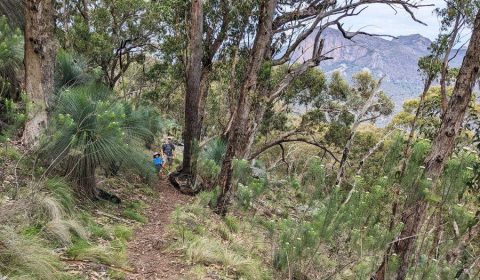
To really appreciate the landscape, you need to get out on the walking tracks. Some viewpoints are accessible on short and easy walks, while others require a much more demanding climb. The reward is worth it: panoramic views over rugged lava domes, forested valleys and wide inland plains.
We explored the park with our 5-year-old, and even though some of the hikes were truly challenging for him, we were all amazed by the scenery and unique rock formations. There was motivation to keep on hiking.

If I had to choose just one hike in the park, I’d choose the Grand High Tops Circuit. It’s the most iconic walk in Warrumbungle National Park and the best way to see The Breadknife and the High Tops.
If you want an easier alternative, the Fans Horizon or the Goulds Circuit walks deliver some similar views—though I wouldn’t even pretend they’re “just as breathtaking”.
If you want a very easy viewpoint walk, Whitegum Lookout is the best choice.
You can read my full guide to the best hikes in Warrumbungle National Park for more information.
Stargaze in Australia’s first Dark Sky Park

Warrumbungle National Park is Australia’s first Dark Sky Park, and stargazing is one of the most memorable things to do here. With little light pollution, dry inland air and wide open skies, the night sky can be extraordinary on a clear evening.
We loved simply lying on a blanket near our campsite and looking up before bed. On one night, we also walked the Wambelong Nature Trail in the dark with head torches and enjoyed the silhouette of the rock formations under a sky full of stars. Some tracks (like the Wambelong Nature Trail) have reflective markers, which helps for night walks, but only go out after dark if you’re comfortable doing so and properly equipped.
For the best stargazing conditions:
- aim for a clear night
- avoid full moon if possible
- visit around the new moon for the darkest skies
- bring a warm layer, even outside winter
- pack a head torch for moving around camp safely
Spot kangaroos and birdlife

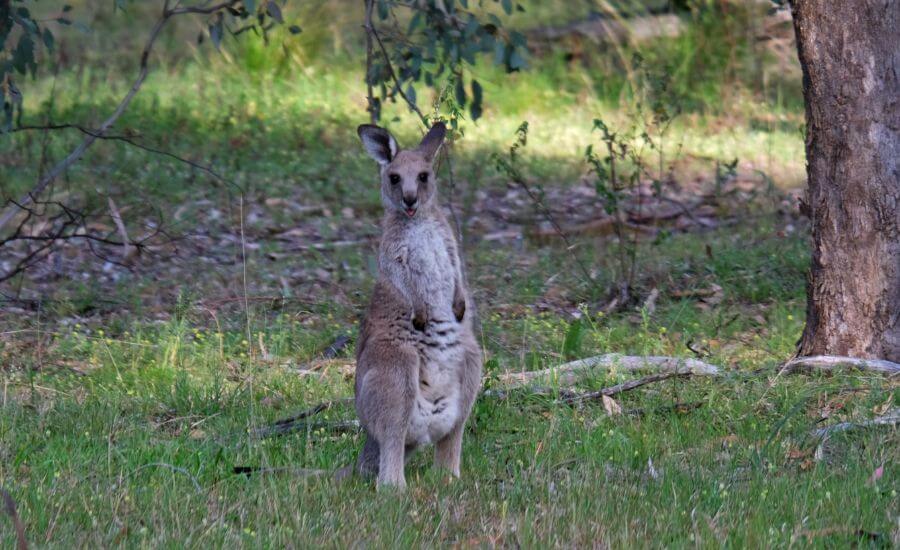
Often it was barely 7 am, and I felt I had already experienced the highlight of the day. Because wildlife was one of the biggest highlights of our stay in the Warrumbungles. The park is full of kangaroos, especially in the grassy valley areas around Camp Blackman, Belougery Flats and the Gurianawa Track. Early morning and late afternoon are the best times to see them.
At times it felt like being inside a nature documentary. We saw kangaroo mums with joeys, groups grazing around the campground and young males sparring in the grass. One morning a mother kangaroo was feeding her joey right behind our tent. And they were usually present as we were preparing our food or went for evening walks around the campground.

We mostly saw Eastern gray kangaroos, occasionally Red-necked wallabies and Brush-tailed rock-wallabies, though these were much shyer and usually higher up on the forested slopes.
Birdlife is rich, too. During our stay we saw cockatoos, kookaburras, parrots, fairy wrens, emus and eagles.
The best easy wildlife walks are:
- Gurianawa Track, between Camp Blackman and the visitor centre
- Belougery Flats circuit
- Wambelong Nature Trail
If seeing kangaroos around camp is part of the appeal, you might also like my guide to NSW campgrounds where kangaroos roam free.
A quick note: kangaroos and wallabies are wild animals. Don’t feed them, don’t approach too closely and always respect their space.
Camp in the park

kangaroos behind our tent
If you want to experience the best of the Warrumbungles, I highly recommend camping inside the park. That’s what we did, too, and it’s the easiest way to be out for sunrise wildlife walks, early morning hikes and stargazing after dark without extra driving.
We stayed at Camp Blackman and loved how easy it was to step straight onto walking tracks from the campground. It also made it much easier to enjoy the park at its best times of day: early morning and evening.
If you don’t camp often, don’t worry. Camp Blackman is one of the more comfortable national park campgrounds we’ve stayed at in NSW, with useful facilities that make a big difference on a multi-day stay. Yes, hot showers included.
My favorite camping gear:
Here’s what has worked best for us after many weekends camping in the Aussie wilderness:
- Dome tent with vestibule – tough enough for coastal wind and mountain drizzle, with room for boots and packs outside
- Self‑inflating sleeping mat – essential for comfort and warmth when the ground gets cold overnight
- Lightweight camp stove – to have your coffee, ham and eggs even on camp days
- Rechargeable LED lantern – bright enough for camp kitchen duty yet gentle enough for inside the tent at bedtime
- Compact cookware set – this basic set comes with a stove
- Foldable camp chair – who needs a reason for them? 🙂
If you’re planning to camp, book ahead for school holidays and long weekends.
Best hikes in Warrumbungle National Park

Hiking is the best way to experience Warrumbungle National Park. The park has a great mix of challenging summit hikes, short scenic loops and easy wildlife walks, so there’s something here for most fitness levels.
If you’re deciding where to start, these are the hikes I’d prioritise:
- Grand High Tops Circuit: best full-day hike and the most iconic walk in the park; see my detailed Grand High Tops guide for more info
- Mount Exmouth: best summit hike and the highest peak in the Warrumbungles
- Wambelong Nature Trail: best short hike (day and night)
- Whitegum Lookout: easiest scenic walk
- Belougery Split Rock: best short technical climb
For trail details, distances and difficulty levels, read my full guide to the best hikes in Warrumbungle National Park.
The Warrumbungles easily deserve a place among the most memorable hikes in the state — these are some of my other favourite hikes in NSW.
Where to stay in Warrumbungle National Park

Camp Blackman
Best for: families, first-time campers and anyone who wants the most convenient base
Camp Blackman is the main campground in Warrumbungle National Park, and it’s where we stayed. It’s a great option if you want easy access, more facilities and several walking tracks starting nearby.
What I liked about Camp Blackman:
- hot showers
- drinking water (from a dedicated tap near the amenity block)
- dishwashing sinks
- powered and unpowered sites
- picnic tables and electric barbecues
- direct access to easy walks and wildlife spotting areas, like Gurianawa Track, Belougery Flats circuit and Wambelong Nature Trai
Camp Blackman reminded me exactly why I love wildlife-rich camping in Australia — if that’s your kind of trip too, here are more NSW campgrounds where kangaroos and other wildlife roam free.
It’s especially good for families and beginner campers because it offers comfort without losing that national park setting. The downside is that it’s busier and less secluded than the smaller campgrounds.
If I stayed in the park again, I’d happily choose Camp Blackman again for the convenience alone.
👉 Check campsite availability for your dates on the NPWS website.
For a road trip to the Warrumbungles, a campervan is a convenient way to combine transport and accommodation, especially if you want to camp inside the park.

Camp Wambelong
Best for: a quieter campground and a simpler camping setup
Camp Wambelong is smaller and more low-key than Camp Blackman, but also accessible on paved roads (it’s directly along the John Renshaw Parkway). It has fewer facilities, but it may suit you better if you prefer a quieter atmosphere and don’t mind a more basic campground.
Facilities are simpler here, with:
- toilets
- picnic tables
- barbecue facilities
It’s also well positioned for some of the trails in this part of the park, including Wambelong Creek, Burbie Canyon and Belougery Split Rock. If you don’t need hot showers or drinking water at camp, this can be a good alternative.
That said, after several more basic campground stays on our NSW trip, we were very happy to have the extra comfort of Camp Blackman.
Remote campsites
Best for: well-prepared backpackers
In addition to the two largest campgrounds — which are also the easiest to access — the Warrumbungles have several remote campgrounds for backpackers, a walk-in campground with basic facilities (Camp Pincham, ~250 m walk from the Pincham car park) and a 4WD accessible campground in a remote area of the park (Gunneemooroo campground, only accessible by 4WD vehicles and in dry weather, because there are two creek crossings and flash flooding can cut off all access in and out of the campground).

Coonabarabran stays
Best for: travellers who want a proper bed, private bathroom and easier cold-weather comfort
If camping isn’t your thing, the best place to stay near Warrumbungle National Park is Coonabarabran. It’s about 30 minutes from the main visitor area of the park and works well as a base for day trips, especially if you want motel accommodation.
You won’t find a huge range of accommodation, but there are a few solid, simple options in town. Staying in Coonabarabran makes the most sense if:
- you’re visiting in winter
- you prefer not to camp
- you want to break up a longer NSW road trip
- you’re travelling with family and want more comfort
My recommended stays:
- Best motel in Coonabarabran: Acacia Motor Lodge — One of the best-rated stays in town, with clean, spacious rooms, an on-site restaurant and a seasonal outdoor pool. It’s also within walking distance of shops, which makes it a convenient base before or after hiking in Warrumbungle National Park.
- Best family-friendly stay: Mu S Boutique Motel “Matthew Flinders” — A newly renovated motel in the heart of Coonabarabran, offering family rooms, and a comfortable base for families or road trippers who want an easy overnight stay close to town services.
Best time to visit Warrumbungle National Park

In general, spring and autumn are the best times to visit Warrumbungle National Park. They offer the most pleasant temperatures for hiking and camping, and they avoid the heat of summer and the freezing nights of winter.
Spring
My favourite time to visit the Warrumbungles. We had dry weather, pleasant daytime temperatures and beautiful wildflowers on our spring visit. Days were warm enough for hiking without being too hot, and nights were mild enough for comfortable tent camping.

Why visit in spring:
- best balance of hiking weather and camping comfort
- wildflowers add extra colour to the landscape
- kangaroo and bird activity is excellent
- good temperatures for long walks
Things to know:
- school holiday periods can book out campgrounds
- powered sites are especially limited, so reserve early
If you can choose your timing, late spring is one of the best windows for a Warrumbungle trip.
We visited during the spring break, which is supposedly among the busiest periods, and we barely met with a few groups on each walking track. Campgrounds need to be reserved in advance though, and Camp Blackman was full during the spring holiday.

Autumn
Autumn is another excellent time to visit. Temperatures are usually pleasant again after summer, making it a very good season for hiking. If you’re mainly coming for walks and want to avoid hotter days, autumn is a great choice.
Why visit in autumn:
- comfortable daytime temperatures
- good hiking conditions
- generally fewer weather extremes than summer
- camping is still enjoyable
Autumn may not have the wildflower display of spring, but it’s still one of the best times to explore the park.

Summer
I would not choose summer for a hiking-focused visit to Warrumbungle National Park. This is inland NSW, and summer temperatures often rise above 30°C. Many of the walking tracks have little shade, and the steeper hikes can feel very exposed in the heat. There aren’t any swimming holes or rivers suitable for cooling off either.
Summer downsides:
- hot hiking conditions
- stronger sun exposure
- more flies (they are the worst in summer)
- afternoon storms are more common
- camping can be uncomfortable in hot weather
If summer is your only option, plan very early starts, keep walks short and carry plenty of water.
Winter
Winter days can still be good for walking, but nights are often very cold (hovering around 0°C on average, but often below freezing). If you’re staying in a heated campervan, caravan or motel, winter can still be a pleasant time to visit. For tent camping, though, it would be much less appealing unless you’re very well prepared.
Why winter may still work:
- crisp, clear days
- quieter atmosphere
- good hiking weather during the day
- excellent dark skies on clear nights
The main drawback is the overnight cold. If you dislike cold mornings or are travelling with young children, another season will probably be easier.

Best time for stargazing
For stargazing, the best time to visit is around the new moon, when the sky is darkest. Clear nights with low moonlight make a huge difference.
If stargazing is one of your main priorities:
- check the moon phase before booking
- choose nights near the new moon
- avoid cloudy or stormy periods if possible
- bring a warm layer, even in the shoulder seasons
Winter skies can be especially clear, but spring and autumn are usually more comfortable overall.
How many days do you need in Warrumbungle National Park?

I think 2 to 3 days is the sweet spot for most visitors.
If you only have 1 day:
- do one major hike or a couple of short walks
- add Whitegum Lookout
- stay for sunset and stargazing if possible
If you have 2 days:
- do the Grand High Tops Circuit on one day
- add a shorter walk like Wambelong Nature Trail or Whitegum Lookout
- spend time wildlife spotting around Camp Blackman or Belougery Flats

If you have 3 days:
- add Mount Exmouth or Belougery Split Rock
- enjoy slower mornings and evenings for wildlife and stargazing
- include an extra easy walk or a nearby detour
If you love hiking, camping or photography, 3 to 4 days is even better. The park rewards a slower pace, especially if you want to enjoy both the daytime landscapes and the night skies.
Is Warrumbungle National Park worth visiting with kids?

Yes, we can confidently confirm this based on our own experience. Warrumbungle National Park can be a great destination for families, especially if your kids enjoy nature, wildlife and camping.
What we enjoyed with a kindergartener:
- lots of kangaroos around the valley and campgrounds
- easy short walks also available
- fun camping experience inside the park
- stargazing is magical (not only for children, I might add)
- plenty of open space and natural variety
Some of the longer hikes are much more demanding, though. Grand High Tops, Mount Exmouth and Belougery Split Rock are better suited to older children or confident young hikers. We hiked extensively in the park with our 5-year-old, but that level of hiking won’t suit every family.

For younger children or first visits, I’d focus on:
- Wambelong Nature Trail
- Whitegum Lookout for an easy view
- Gurianawa Track and Belougery Flats for wildlife
- Fans Horizon or Goulds Circuit for a steeper hike with big views
- easy wildlife watching around camp
If your family likes the outdoors, the Warrumbungles are one of the more memorable nature-based family trips in regional NSW.
For those visiting with younger kids, bringing a few Australian nature books can make the wildlife and birdlife even more exciting before and after your walks — these are our favourite Aussie nature books for preschoolers.
What to see near Warrumbungle National Park
Hickeys Falls

I know I told you there’s no swimming holes in the Warrumbungles, but here’s one that’s not far. Just one hour drive from the visitor center or half an hour drive from Coonabarabran, Hickeys Falls is just off of the Newell Highway. There’s a paved car park and a few picnic benches along the road, but if you walk about 50 meters, you’d find yourself in paradise: a small creek, towering rock walls and a lovely waterfall, with a deep pool that’s refreshing for a swim.
Hickeys Falls exceeded my expectations, both the general scenery and the waterfall. Who would have thought of anything like that when stopping at a random roadside picnic area?
Mount Kaputar National Park

Mount Kaputar National Park is a great extension if you want to turn your Warrumbungle trip into a bigger inland NSW nature itinerary. It’s around 2.5 hours away and offers more volcanic scenery, scenic drives, lookouts and hikes.
We combined both parks on our trip, and they worked really well together. If you enjoy mountain landscapes and quieter national parks, it’s a very worthwhile addition. See my Mount Kaputar National Park guide here.
Pilliga Sandstone Caves & Pilliga National Park
Between the Warrumbungles and Mount Kaputar, or rather between Coonabarabran and Narrabri, the 100 km of the Newell Highway travels through the Pilliga Forest, an expansive woodland and that typical red soil that you see on pictures from the Outback. It surely left its mark on our car. 🙂
Pilliga National Park consists of plenty of unpaved red dirt roads, some picnic areas and hiking trails. It’s a great place for bird-watching, and its Sandstone Caves are spectacular. At least, I suppose so, because sadly, the trail to the cave system was closed due to damage during our visit.
Final thoughts

Warrumbungle National Park surprised me in the best possible way. Between the volcanic peaks, the huge mobs of kangaroos, the peaceful campgrounds and the extraordinary night skies, it is truly one of NSW’s stunning hidden gems.
If you enjoy hiking, camping and wild landscapes, it’s absolutely worth the drive.
FAQ: Visiting Warrumbungle National Park

Yes, absolutely. Warrumbungle National Park is one of the best national parks in inland NSW for hiking, wildlife, camping and stargazing. It feels far less crowded than many better-known parks and offers a very distinctive volcanic landscape.
Warrumbungle National Park is best known for its volcanic rock formations, scenic hiking trails, dark skies, kangaroo-filled valleys and excellent stargazing. It is also Australia’s first Dark Sky Park.
Most visitors should spend 2 to 3 days in the park. That gives you enough time for one major hike, a few shorter walks, wildlife spotting and at least one evening of stargazing.
Spring and autumn are the best times to visit the Warrumbungles. These seasons offer the most comfortable temperatures for hiking and camping and avoid the harshest summer heat and cold winter nights.
Yes, you can stay inside the park at campgrounds including Camp Blackman and Camp Wambelong. Camping inside the park is the best way to enjoy sunrise wildlife, evening walks and stargazing without extra driving.
If you want to camp, Camp Blackman is the best all-round base thanks to its facilities and location. If you prefer a motel or cabin-style stay, base yourself in Coonabarabran.
Yes, Warrumbungle National Park can be very good for kids, especially if they enjoy wildlife, camping and short walks. There are easy family-friendly options, but some of the major hikes are quite demanding.
Yes, kangaroos are one of the highlights of the park. Early morning and late afternoon are the best times to see them, especially around Camp Blackman, Gurianawa Track and Belougery Flats.
Yes, it’s one of the best places in Australia for stargazing. Warrumbungle National Park is Australia’s first Dark Sky Park and offers very dark skies with minimal light pollution.
Leave a Reply