
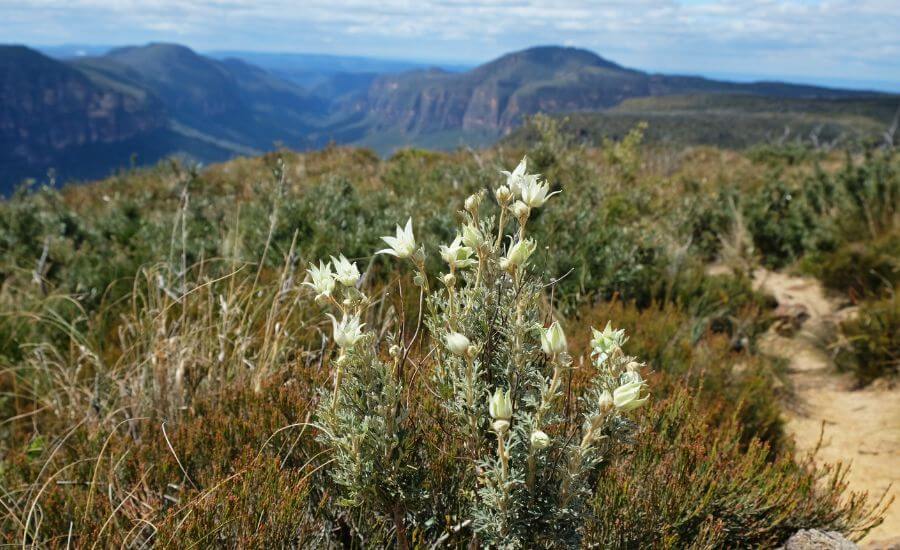
Spring is one of my favourite times to hike in the Blue Mountains. The weather is ideal for those scenic, exposed ridge walks that get brutally hot in summer, the big escarpment views are clear on crisp mornings, and the bush starts putting on a surprisingly beautiful wildflower display. I love the sunshine on my face and the excitement of spotting a vivid red waratah as we drive along a long unpaved road through the bush towards the trailhead.
In the Blue Mountains, spring flowers mean exposed sandstone heath full of flannel flowers and boronias, wattles, tea-tree flowers and hakeas decorating the ridgelines, and waratahs standing tall in the bright, dry bush. Cliff-edge heathlands, open woodlands and sunny ridges are all connected to flowering bush in my mind, because those are the hikes we usually save for early spring, when the days are longer and the weather is just about perfect for hiking: not too cold, and not too hot either.

It took me a few years to work out my ideal Blue Mountains hiking schedule after we moved to Sydney, and I’m still on the lookout for new additions to it — I suspect that’s just an ongoing thing here. But by now I do have a delightful list of Blue Mountains wildflower walks to share, including some proper hikes with big rewards and some shorter, easier options.
Since I hike with my husband and our back-then-3, since-then-7-year-old son, I’ve also included a quick note on whether each walk is realistic with kids. Not all of them are typical family hikes, but we’ve done every one of them with our actively hiking boy. Some are very doable with younger kids, while others are better suited to older children.
If you’re also planning your walks seasonally, you might like my guide to when to hike in Sydney, which covers the best seasons for different types of tracks around Sydney and beyond.
Quick picks: best Blue Mountains wildflower walks by type

Best easy walk:
- Mount Tomah Botanic Garden
Best short hike:
- Mount Banks summit walk
Best wildflower hikes for panoramic views:
- Lockleys Pylon
- Mount Hay and Butterbox Point
- Hat Hill to Bald Head

Best for dramatic rock formations and flowers:
- Fortress Ridge and Dr Dark’s Cave
- Hanging Rock
Best for young kids:
- Mount Tomah Botanic Garden
- Mount Banks summit walk
Best for a full bushwalking day:
- Fortress Ridge and Dr Dark’s Cave
- Pierces Pass to Grose River, and further to Blue Gum Forest

Best for photographers:
- Mount Hay and Butterbox Point
- Fortress Ridge and Dr Dark’s Cave
- Lockleys Pylon
Best near Katoomba (accessed via Mount Hay Road):
- Fortress Ridge and Dr Dark’s Cave
- Lockleys Pylon
- Mount Hay and Butterbox Point

Best near Blackheath:
- Hat Hill to Bald Head
- Hanging Rock
Best along Bells Line of Road:
- Mount Tomah Botanic Garden
- Mount Banks summit walk
- Pierces Pass to Grose River
If this is your first hiking trip to the area, you might also want to read my guide to the best Blue Mountains walks for first-timers.
Planning your Blue Mountains wildflower trip

If you’re visiting from Sydney, some of these walks can be done as a long day trip, especially the Bells Line of Road hikes and the easier options. But if you want to combine a few of the best wildflower walks, it’s much more enjoyable to stay overnight in the mountains.
Katoomba works really well as a base for all the hikes along Mount Hay Road, while Blackheath is convenient for easy access to Hat Hill Road and the Hanging Rock hike.
My recommendations for Blue Mountain stays:
- In Katoomba: Carrington Hotel – best for historic charm, couples, first-time visitors
- In Blackheath: Kyah Motel – best for solitude and proximity to nature
- Budget-friendly option: YHA Blue Mountains Katoomba – best for an affordable stay with private rooms
If you’re planning a weekend away rather than a rushed day trip, you can also combine these hikes with lookouts, cafes and some of the classic Blue Mountains sights. I’ve mapped that out in my 3-day Blue Mountains itinerary here.
In case you’d stay closer to the trailheads, my Blue Mountains camping guide has many great options for a nature-focused trip.

Driving to the trailheads: unpaved roads and roadside waratahs
Many of the best wildflower walks in this article are reached via unpaved roads, like Mount Hay Road, Mount Banks Road and Pierces Pass Road. In dry weather and normal road conditions, these are usually manageable in a standard car — no high clearance or 4WD is required. We do have a high-clearance car, and that definitely makes some sections feel more relaxed, but it hasn’t been essential in good conditions.
Here’s one of my shots of the Pierces Pass Road in 2024:

And here’s how Mount Hay Road looked like in 2023:

This is just to give you an idea and not to indicate current conditions, of course. With that said, Mount Banks Road and Pierces Pass Road are both quite short and generally very well maintained. Mount Hay Road is also regularly maintained, but it can feel bumpier and rockier depending on recent conditions.
2026 spring update: Mount Hay Road is actually closed for maintenance for a longer period. Please check the national park website for updates.
There’s another reason not to rush these drives in spring: you have a very good chance of spotting waratahs along Mount Hay Road, Mount Banks Road and Pierces Pass Road even before you reach the trailhead. Some of our most spectacular waratah sightings in the Blue Mountains have happened from the car window on the way to the walk.
When wildflowers bloom in the Blue Mountains
Wildflower season in the Blue Mountains usually starts in late winter, around August, and runs through spring, often peaking in late September and early October. But exactly when — and what — you see depends on rainfall, temperature, elevation and recent fire history as much as the calendar. Some years feel spectacularly flower-filled, and some are less impressive. The views are always there for you, though.
Wildflowers in August

August is when spring starts to stir in the Blue Mountains. Wattles are already brightening up parts of the bush, and on warmer slopes or lower sections of the tracks you may start noticing early heath flowers as well. It’s a lovely time to be out hiking, but usually still a bit early for the full wildflower show.
In late winter, look out for:
- wattles
- early hakeas
- some heath and tea-tree flowers
- broadleaf drumsticks, which can start flowering from late winter and continue well into the warmer months
Wildflowers in September


September is usually the best month for Blue Mountains wildflower walks. It’s also one of the best months for hiking generally: cool enough for exposed ridges, but with that longer-day spring feeling.
This is when many heathland shrubs and sandstone plants flower at once, especially on open ridges and cliff-top tracks. NSW waratahs usually flower in the first half of September, though at higher elevations they can still be going later in the month.
In late September, we regularly see:
- flannel flowers
- boronias
- hakeas
- pea flowers
- pink buttons
- vanilla lilies
- grevilleas
- broadleaf drumsticks
This is the month when a lot of Blue Mountains wildflower walks are at their most rewarding. Exposed ridgelines, heathlands and open woodlands are especially stunning.


Wildflowers in October
Depending on the year, October is peak spring for many Blue Mountains hikes and often an ideal time if you want to see a wide range of flowers in one walk. Ridgelines and heathland tracks can still be full of interest, and October offers longer daylight hours than late winter and early spring days.
Along with many of the September flowers still hanging on, October can also be good for:
- boronias
- flannel flowers
- hakeas
- tea-tree
- trigger plants
- dwarf purple flag
- later pea flowers and grevilleas
Personally, I’d aim for the first half of October. That usually gives you a better chance of variety, and the hiking temperatures are often more pleasant than later in the month.


Wildflowers in November
By November, some of the earlier spring flowers are starting to fade, but there can still be plenty to see depending on altitude and local conditions. Higher, cooler areas may still hold onto spring colour a little longer, while some species continue flowering well into early summer — the beauty of Australia: long blooms. (I know it’s probably not only Australia, but after growing up in Europe, moving to Australia introduced me to this experience.)
November can be a good month to spot:
- later boronias
- some grevilleas
- hakeas
- tea-tree
- broadleaf drumsticks
- occasional lingering wattles, depending on the species and location
It’s not that classic early-spring “everything is flowering at once” moment, but there’s often still enough around to make a wildflower-focused hike worthwhile.
Common spring wildflowers on Blue Mountains hikes


You don’t need to know the name of every flower to enjoy wildflower season in the Blue Mountains, but it does make the walks even more fun once you start recognising a few regulars. And my son keeps asking me all the time, so I had no choice but to do some research, anyway.
So these are some of the spring flowers and flowering plants we most often notice on Blue Mountains hikes:
- Flannel flowers — soft, starry white flowers; a typical spring beauty on exposed sandstone tracks
- Boronias — delicate pink flowers that always feel like a reward for looking closely
- Wattles — several different species, but most of them impress with bright yellow bursts from late winter into spring
- Hakeas — spidery or sculptural flowers, depending on the species
- Tea-tree and heath flowers — often tiny white or pink blooms that can make the bush feel spectacular
- Pea flowers — cheerful yellow, orange or red pops of colour on low shrubs
- Grevilleas — varied and often striking; some are truly spider-like, others would fit a bride’s bouquet
- NSW waratahs — the showstoppers of the Sydney sandstone world
- Trigger plants — small, fascinating flowers, but you need to take a closer look to notice it
- Native orchids — rare and never guaranteed, but very exciting
- Vanilla lilies — another one that rewards a closer look; their vivid purple almost contradicts their name
- Pink buttons — small but cheerful little clusters of colour
- Dwarf purple flag — lonely violet-blue flowers with exactly three symmetrical petals
- Broadleaf drumsticks — one of the stranger-looking spring flowers, but it is indeed a flower

Now, please note that I’m not an expert in native Australian wildflowers, but I do enjoy spotting, identifying and photographing them. I might make mistakes though, and it’s very likely that I’m not familiar with all the species and subspecies, so use this summary as a starting point and not as a comprehensive wildflower species guide.
Best spring wildflower walks in the Blue Mountains

A quick overview first — scroll down for more details:
| Walk | Distance | Best for | Exposure | Facilities | Best flowering period |
| Mount Tomah Botanic Garden | Flexible | Families, prams, grandparents, or as a no-hike option | Low | Toilets, café, visitor centre | September to October |
| Mount Banks summit walk | 2.5 km return | Road trippers along the Bells Line of Road, or as an additional shorter hike, families with active kids | Moderate to high on ridge sections | Toilets at picnic area | September to early October |
| Mount Hay & Butterbox Point | 3 km return for Butterbox Point only; 6 km return with Mount Hay | Short scenic wildflower walk, panoramic views, families with older kids | Moderate to high on cliff-edge sections | None | September to early October |
| Lockleys Pylon | 7.2 km return; 8.5 km with Du Faur Head | Wildflowers (waratahs, too), big views without a huge day, active families | Moderate to high on open ridge sections | None | September to early October |
| Hat Hill to Bald Head | 6.5 km return | Heathland flowers, scenic views from the ridge, active families | Moderate to high, especially near the end | None | September to early October |
| Fortress Ridge & Dr Dark’s Cave | Up to 10 km return | Good variety (panoramic views, flowering shrubs, rock formations), challenging bushwalk | Moderate to high, particularly at the Fortress Ridge Lookout | None | September to early October |
| Pierces Pass to Grose River | 6.2 km return to river, longer if exploring further | Full-day hikers, varied habitats, natural swimming holes in Grose River | Low to moderate exposure, but steep track | Toilets at picnic area | September to November |
| Hanging Rock & Baltzer Lookout | Around 11 km return | Long, but not steep walk, extraordinary rock formation, flowering shrubs | Generally low, but high at the cliff-edge end section at Baltzer Lookout | None | September to early October |
Exposure refers mainly to cliff edges, open ridges and the kind of terrain that may feel stressful with young children.
Mount Hay and Butterbox Point
- Distance: 3 km return for the Butterbox Point circuit only; 6 km return if you add Mount Hay
- Time: Allow around 1.5 hour for Butterbox Point only; 2.5 to 3 hours if you include Mount Hay
- Difficulty: Easy for Butterbox Point; Moderate if you add Mount Hay
- Trailhead: Mount Hay Road trailhead at the end of Mount Hay Road, near Leura
- Facilities: none at the trailhead, so bring water, snacks and anything else you need
- See the exact route we completed on a trail map here.

Flowers and views really work together on this track to surely impress you. It’s a classic Blue Mountains mix of cliff-edge heath, open bush, some strangely shaped rock formations, giant red canyon walls and Grose Valley views.
If you continue to Mount Hay, the track becomes rougher, steeper and less well defined, with a short scramble, and some overgrown sections. Finding the actual route to the summit can be trickier. Since the best views are actually on the Butterbox Point circuit, Mount Hay is really an optional add-on rather than a must-do. (But who would finish a hike at 3 km and call it a day, right?)
What wildflowers or heathland to expect

This is exposed sandstone country, and one of the most rewarding spring walks in the Blue Mountains. The Butterbox Point circuit is relatively easy, but the scenery is fantastic: open ridgeline views, sandstone outcrops and low heathland full of spring flowers.
We enjoy it the most in late September, and we often spot flannel flowers, boronias, wattles, hakeas, tea-tree, pea flowers, wax flowers and other flowering heath species, along with grass trees. I’ve never seen orchids but this is the kind of place to look for them.
Best time for the Butterbox Point and Mount Hay walk

September to early October is usually the sweet spot, although late August can already be lovely in a good season.
Is it doable with kids?

Yes, Butterbox Point can be a great option with hiking kids. It’s fairly short and mostly easy-going, with little elevation change. However, it won’t be a relaxed family stroll, because there are exposed cliff-edge sections and one narrow bit of track that may not suit every child (or adult who is uncomfortable with heights).
The Mount Hay addition is better for kids who are comfortable on rougher, less obvious bush tracks. We completed the extended version when our son was 5.
Lockleys Pylon
- Distance: 7.2 km return; 8.5 km return if you add Du Faur Head
- Time: Allow around 3 to 3.5 hours, including Du Faur Head
- Difficulty: Moderate
- Trailhead: Lockleys Pylon trailhead on Mount Hay Road, near Leura
- Facilities: none at the trailhead, and parking is limited
- See the Lockleys Pylon walking route on a trail map here.

If you’re after a relatively easy Blue Mountains hike that absolutely delivers on views, Lockleys Pylon is such a good choice. It’s in a quieter part of the national park, and although the start is not especially exciting, the last kilometre is spectacular enough to make you forget all about that. Once you reach the open ridge, the views really open up, with huge sandstone escarpments, Grose Valley cliffs and that lovely feeling of suddenly being out in the wild.
If you have the energy, Du Faur Head is a great add-on. It only adds a little distance, but it does involve a steeper descent and climb back out, with a few rocky sections. The views are superb and feel far more remote than you’d expect for such a relatively short extension.
What wildflowers or heathland to expect


This is another lovely spring walk for classic sandstone heath and ridgeline flowers. The first part of the trail is more enclosed, but that’s where we spotted several blooming waratahs.
Once you reach the open sections, the low vegetation and rocky ridgeline make it much easier to notice the flowers around you. Flannel flowers, wattles, hakeas, tea-tree, pea flowers, wax flowers, boronias and other small heathland blooms are typical here. These flowers are easy to miss if you charge through, but very rewarding if you slow down and take a closer look.
Best time for the Lockleys Pylon walk

September to early October is usually the best time, especially if you want the mix of good hiking weather and wildflowers. We usually spot the waratahs here (and generally along Mount Hay Road) in late September.
Is it doable with kids?

Yes, if they’re used to walking longer distances. Our 4-year-old happily walked it all the way, though not within 3 hours, rather closer to 5. But that’s the thing when hiking with younger kids: they enjoy “lingering” the most. If we let him observe the small flowers and bugs, and collect the interesting pebbles on the way, he’ll be glad to be on the trail. For actual progress, we use the next snack break as motivation.
The main Lockleys Pylon track is not especially steep, but the terrain is often rocky, and there are exposed areas on the ridge. Du Faur Head is better as an add-on for strong hiking kids, as the side trail is steeper and rougher.
Hat Hill to Bald Head
- Distance: 6.5 km return
- Time: Allow around 2.5 to 3 hours
- Difficulty: Moderate
- Trailhead: where Hat Hill Road meets Perrys Lookdown Road (Blackheath)
- Facilities: none at the trailhead, but parking is usually easy here
- See the Hat Hill to Bald Head route on a trail map here.

This is one of those lesser-known Blue Mountains walks that gives us a true sense of adventure without actually being difficult. The track climbs over Hat Hill, crosses the open ridgeline, and continues through the bushland before reaching the final steep section to Bald Head.
It’s not an officially signposted walk though. The path is mostly quite clear, but there are a few junctions and sections where it helps to know where you’re going. The last stretch out to Bald Head is the toughest part of the hike, with a steep descent followed by a steep climb back up to the viewpoint (yes, these kinds of descents can be quite demotivating, but do carry on).
It’s among those Blue Mountains hikes where we usually enjoy the views into Grose Valley in perfect solitude.
What wildflowers or heathland to expect


This is a beautiful spring walk if you enjoy open bushland and sunny sandstone ridges. There’s variety: open terrain near Hat Hill and thicker bush further on. Spring typically means boronias, flannel flowers, hakeas, wattles, tea-tree, pea flowers, trigger plants and other low heath species along this track, especially in the more open sections. The flowers combined with the whole ridgeline landscape makes the hike truly memorable.
Best time for the Hat Hill to Bald Head walk
For flowers, September to early October is usually the best time, when the heathland is at its liveliest. But this hike is so scenic that it’s a good choice any time between May and October when the weather is pleasant for exposed ridge walks.
Is it doable with kids?

Yes, kids who are comfortable on moderate bushwalks can cope with this walk. But it’s not a family stroll, and the final section to Bald Head is steep enough to feel like real hiking. We found it a rewarding hike with a 5-year-old.
Fortress Ridge and Dr Dark’s Cave
- Distance: 10 km return if you do Fortress Rock, Dr Dark’s Cave and Fortress Ridge together; shorter if you only do part of the walk
- Time: Allow around 4 to 5 hours for the full hike
- Difficulty: Moderate for Fortress Ridge; hard if you add Dr Dark’s Cave
- Trailhead: 8 m down Mount Hay Road, near Leura
- Facilities: none at the trailhead
- See the exact route we did: the trail map of Fortress Rock, Dr Dark’s Cave and Fortress Ridge Lookout.

This is one of the most adventurous walks we found in the Blue Mountains. Fortress Ridge itself is already a brilliant hike, with huge Grose Valley views and far fewer people than the more famous lookouts. Adding Dr Dark’s Cave adds more variety and makes it really memorable.
The cave, used by Eric Dark and his family as a holiday refuge from the late 1930s, still contains old domestic items, features a small waterfall (seasonal) and is magically atmospheric. The path towards the cave passes by some quirky rock formations and typical Blue Mountains rock overhangs.
So the full walk is made up of three parts: Fortress Rock, Dr Dark’s Cave and Fortress Ridge. Fortress Rock is a relatively easy detour to one of the best lookouts on the route, while Dr Dark’s Cave is the difficult, rougher section. Fortress Ridge is reachable by taking another junction, and it’s a moderate ridge walk.

If dramatic sandstone scenery is as much of a draw for you as the wildflowers, you might also like these three Blue Mountains hikes with stunning rock formations.
What wildflowers or heathland to expect
This is a wonderful spring hike for dramatic sandstone scenery and flowering heathland. The ridge sections are the best for wildflowers, while Dr Dark’s Cave has ferns, overhangs and other rock formations.
The open sections are often richly decorated with flannel flowers, boronias, wattles, hakeas, tea-tree, pea flowers, banksias, and grass trees. The flowers add richness to an already spectacular landscape here.
Best time for the Fortress Ridge and Dr Dark’s Cave walk
September to early October is usually the best time for wildflowers, but this is a spectacular walk any time in cooler weather.
Is it doable with kids?

This depends very much on which version of the walk you do. Fortress Rock on its own is a short, family-friendly walk. Fortress Ridge can work with kids who are comfortable with a proper bushwalk. Dr Dark’s Cave is better suited to older, experienced hiking kids who are confident on rough, overgrown and uneven terrain. We waited with this one until our son turned 6.
For most families, I would treat the cave as an adults-or-very-capable-kids add-on rather than the default plan.
Pierces Pass to Grose River (or Blue Gum Forest area)
- Distance: 6.2 km return to the Grose River, plus a little extra if you explore the swimming spots; much longer if you continue all the way to Blue Gum Forest
- Time: Allow at least 3.5 to 4 hours for the river walk, much longer if you plan to swim or explore properly
- Difficulty: Moderate to hard (steeper sections)
- Trailhead: Pierces Pass Picnic Area at the end of Pierces Pass Road, a short detour off Bells Line of Road near Mount Wilson
- Facilities: toilets at Pierces Pass Picnic Area (but no water!)
- See the exact route we walked on the Pierces Pass track on a trail map here.


This is one of the most rewarding spring walks in the Blue Mountains if you want something more challenging and a bit different from the classic ridge-and-lookout format. The Pierces Pass track drops down through forest and rainforest gullies to the Grose River, and occasionally the descent gets quite steep (and yes, you’ll do the climbing on the way back, so keep that in mind).
The river doesn’t only impress with the scenery, but also with the water itself: clear pools between huge boulders, with towering red mountains in the background. Some pools are deep enough for swimming, too. It’s one of the wildest river stretches we’ve found in the Blue Mountains on a day hike — and that’s why I’d recommend planning it as a full day hike, because you’d want to linger at the bottom.

But keep in mind that this section which I marked on the map only covers the walk down to the river. That’s what we did as a family hike. You can continue all the way to Blue Gum Forest if you’re after a much bigger day, but even just walking to the river makes a fantastic hike on its own.
The track is well maintained and easy to follow. It’s steep and has lots of steps, but it’s not a technical hike, just an exhausting one as you climb back up at the end of the day.
What wildflowers or heathland to expect

Wildflowers are also different here than on the exposed sandstone heath walks. You get a mix of dry forest, shady gullies, rainforest and river-edge vegetation.
In spring, you can spot orchids, flowering shrubs, creekside plants, and fresh regrowth in the gullies. We saw golden wattles and tea-tree shrubs in bloom. Overall, the wildflowers are not as spectacular as on the heathland flower walks, but combining them with the views and the different habitats still make it an unforgettable hike.
Best time for the Pierces Pass walk
September to November can all work well here for the flowering shrubs. Early to mid spring is lovely for cooler hiking weather, but as the warmer days arrive, you can take advantage of the swimming holes at the river.

Is it doable with kids?
Yes, with hiking kids who can manage lots of stairs and a steady climb back out. The terrain is not especially tricky on the main track, but the elevation change makes it more demanding than the distance suggests.
If you plan to explore the river beyond the main crossing, that adds a more adventurous element. Of course, the pools were the highlight for my son. Just be careful around rocks and slippery edges. Water levels are generally low, but it’s still a wild river, and the flow can change with recent rainfall.
Mount Banks summit walk
- Distance: 2.5 km return on the ridge trail
- Time: Allow around 1.5 hours
- Difficulty: Moderate (short but steep)
- Trailhead: Mount Banks picnic area off Bells Line of Road, near Mount Tomah
- Facilities: toilets at the picnic area
- See the Mount Banks summit track on a map here.

Mount Banks is one of the best short hikes in the Blue Mountains, especially if you’re driving the Bells Line of Road. It’s a quick dose of spring bush and big escarpment views, with a proper uphill effort. Still it’s one of the easiest wildflower walks on this list, because it’s so short — and even shorter if you only do it until the halfway point, which offers the best view, anyway.
Because yes, Mount Banks summit itself is quite underwhelming, I have to admit, but the ridge walk up there is worth doing. And I’d recommend the ridge trail rather than the road/fire trail option. It’s more beautiful, and gives you the dramatic Grose Valley views. But don’t expect a sweeping summit panorama at the top: Mount Banks is forested, and the actual summit is more about reaching it than standing there saying wow.
What wildflowers or heathland to expect
Mount Banks has richer vegetation than many sandstone ridge walks, and in spring the track feels wonderfully alive. Along the ridge and open sections, we usually spot hakeas, boronias, and pea flowers, with lovely flowering shrubs mixed through the bush.
Best time for the Mount Banks summit walk

September to early October is usually the time when most of the spring flowers are out. But the shrubs start flowering in the winter and continue so throughout spring and early summer. Since it’s such a short walk, it can easily fit into a Blue Mountains itinerary in any season.
Is it doable with kids?
The short distance makes it one of the most family-friendly wildflower hikes in the Blue Mountains, but it doesn’t mean it’s a family stroll. It’s a proper little adventure with steep terrain, roots and rocks, and some exposed sections where it’s best to keep young kids within arms reach.
Also, the wind forecast is something to consider before you set off. We completed this walk several times with my son, and one time we had to turn back even before the halfway point because the wind was in full force, and it scared him very much (it made me somewhat worried, too). As we learnt later, Mount Banks sits on an exposed ridge that creates a natural wind funnel.
Hanging Rock & Baltzer Lookout
- Distance: around 11 km return
- Time: Allow around 4 to 4.5 hours
- Difficulty: Moderate
- Trailhead: end of Ridgewell Road, Blackheath
- Facilities: none at the trailhead
- See the exact route to Hanging Rock on a trail map here.


Most of the walk towards Hanging Rock is normally quite boring, because it runs on a wide fire trail. But it leads to one of the most extraordinary rock formations in the Blue Mountains: the Hanging Rock — and stunning panoramic views of the Grose Valley from Baltzer Lookout.
But let me get back to Burramoko Fire Trail, which you’ll follow all the way to the lookout. Even though it’s a bit boring for most of the year, spring time is an exception. Because this fairly flat fire that runs through open forest and high-altitude ridge heathland is full of flowering shrubs and wildflowers in spring.
Then right at the end, the track drops towards Baltzer Lookout, the cliffs suddenly open up, and the final side track towards Hanging Rock takes your breath away. You do not need to walk onto Hanging Rock itself — and you shouldn’t. The best views are from the ridge opposite, where you can really appreciate the scale and shape of it. It looks like part of the cliff has been sliced away and left hanging in space. (And who knows how long it will be hanging.)

What wildflowers or heathland to expect
The fire trail section leads through open sclerophyll forest, and the flowering shrubs make it really pretty from late winter to early summer. You might see blooming wattle trees, tea tree shrubs, native peas, hakeas and drumsticks. Waratahs like this kind of habitat, as well.
This is a walk where the flowers are part of the overall atmosphere and make the long fire trail much more enjoyable. But the main attraction remains to be at the end of the trail.
Best time for the Hanging Rock walk
September to early October is usually best, when the weather is ideal for longer exposed walks, and you can see the bush at its most colorful.
Is it doable with kids?

Yes. It’s a long walk, but the elevation change is minimal. Kids who are used to covering this distance will easily complete it. Though I have to add that easy terrain is usually not the most exciting for kids, at least that’s our experience, and if you tackle this walk in warm weather, you can expect a lot of complaints.
The cliff-edge environment at the end is a place to be vigilant when visiting with kids. You’ll be at the top of the cliff wall without any fencing. Even sensible older kids need close supervision near the lookout and ridge.
Easy Blue Mountains spring walk option: Mount Tomah Botanic Garden

If you want spring flowers without doing a proper hike, the Blue Mountains Botanic Garden at Mount Tomah is the easiest option and a very convenient stop on a Bells Line of Road day trip. It’s not a bushwalk like the other trails here, but it’s still a lovely place to spend a spring morning or afternoon, especially with very young kids or elderly grandparents. Or for anyone who wants flowers more than hiking.
One of the best things about Mount Tomah is that you can make the outing as short or as long as you like. There are easy paths, labelled plantings, and plenty of seasonal color. It also works beautifully as a backup plan if the weather is not ideal for one of the longer ridge hikes, or as an addition before or after the Mount Banks summit walk.
Not every spring day has to be a proper hike — if you’d rather keep things easy, here are my favourite easy-access viewpoints in the Blue Mountains.
Best Blue Mountains wildflower walks with kids

If you’re hiking with kids, the best option really depends on what kind of family bushwalkers you are. If you’re hiking with a toddler, you’ll likely need a child carrier. If your child is older, you’ll know their abilities best.
We’ve hiked regularly with our son since he was born. We carried him for the first 3 to 4 years, but once he wanted to walk, he did, so he got used to rough, rocky and rooty terrain from the beginning. By age 5, he was a fully independent walker — and realistically, we couldn’t have carried him longer anyway. We’re usually out hiking somewhere on most weekends, and he first completed all of these hikes with us when he was 4 to 5 years old. So when I say that an active hiking child can manage these walks, that’s what I mean.
However, if this will be your first family hike with a 4-year-old, that’s a very different story. That’s why it’s so hard to give general family recommendations for hiking. But I’ll do my best.

Obviously, Mount Tomah Botanic Garden is the easiest and least stressful option. You can visit with a pram, too. There’s a visitor centre, toilets and a café.
And here are my recommendations for actual Blue Mountains bushwalks:
- Best with toddlers: Fortress Rock walk — 3 km return, on a wide and fairly flat track, with no exposed sections. It’s a shorter part of the Fortress Ridge hike.
- Best with older kids as a first hike: Butterbox Point (without Mount Hay) or Mount Banks summit — both are short, adventurous and rewarding, but they do include exposed sections and drop-offs.
- Best with actively hiking young kids (around 4 to 6 years): Lockleys Pylon, Fortress Ridge (without Dr Dark’s Cave), Hat Hill to Bald Head, Mount Hay & Butterbox Point — these are proper hikes on scenic ridges, with relatively little elevation gain and big views.
- Best with older or very experienced kids: Fortress Ridge & Dr Dark’s Cave, Pierces Pass to Grose River — these are the longest and most physically demanding hikes on this list.
Hanging Rock is a bit of an outlier. The terrain is quite easy for most of the walk — wide and almost flat — but the distance is long, and it’s not the kind of trail where you want to turn back halfway because the real reward is at the end. The cliff exposure at the end can also be stressful with little kids.
So I’d choose a hike based not just on fitness, but also on your child’s experience, supervision needs, and comfort around exposed viewpoints. Track conditions, weather and cliff-edge risks can change quickly in the Blue Mountains. So always check the latest NSW National Parks alerts before setting out, and choose a walk that matches your family’s actual experience level.
And if you’re hiking with a toddler or just starting out with family bushwalks, I’ve also put together a collection of very easy walks for hiking with toddlers in and near Sydney.
Tips for walking during wildflower season

Stay on track. This matters all year, but especially in spring. Blue Mountains heathland is fragile, and it’s very easy to damage plants by stepping off track for a better photo or a closer look.
Don’t pick the flowers. It should go without saying, but please leave them where they are. Many wildflowers are delicate or slow-growing.
Watch for snakes. Spring is snake season too. You don’t need to be paranoid, but it’s worth being alert, especially on warm days and quieter tracks. Wear proper shoes, watch where you step, and keep kids from charging through long grass.
Be ready for changing weather. One of the best things about spring hiking is the cooler weather, but conditions can still swing quickly. Exposed ridges can be windy, and it’s colder at higher elevations.
Expect crowds on fine weekends. If you’re heading to a well-known walk like Lockleys Pylon or Mount Tomah on a beautiful spring weekend, you won’t be the only one with that idea.
What to pack for Blue Mountains spring walks

Spring is one of the best times to hike in the Blue Mountains. But cool mornings or sudden wind justify putting some extra thoughts into packing. And the views and wildflowers will compete for your attention, which can result in longer time on the trails than initially planned.
These are mostly exposed ridge and heathland walks, often with no facilities at the trailhead, limited shade, and very changeable weather. Even on a sunny spring day, it can feel cool at the start, warm by midday, and surprisingly windy on the ridgelines.

What I’d pack for these Blue Mountains wildflower walks:
Proper hiking shoes or trail runners. Many of these tracks are rocky, uneven or sandy, and some have roots, loose stones or short steep sections.
We like the Columbia Newton Ridge Plus boots; they’re lightweight, supportive, and affordable:
👉Columbia Newton Ridge Plus II boots for men
👉Columbia Newton Ridge Plus boots for women
Layers. Especially a warm top for early starts and a light rain jacket or windproof layer for exposed ridges.
Lightweight windproof and waterproof jackets like the Columbia Women’s Arcadia or the Columbia Men’s Watertight are practical choices throughout the seasons.
Plenty of water and snacks. Most of these walks have no water available anywhere along the route (nor at the trailheads). A hydration bladder is very practical, and it makes water access really easily.
Hat and sunscreen. Spring sun is lovely, but many of these trails are very exposed. We wear wide-brim hats like these for hiking near Sydney all year.
Downloaded map or navigation app. Particularly for less obvious routes like Hat Hill to Bald Head or longer trail combinations like Fortress Ridge and Dr Dark’s Cave.
Basic first aid kit. Useful on any bushwalk, especially with kids.
Child carrier. Makes most of these trails manageable if you’re hiking with a toddler.
For some of these tracks, I’d also consider trekking poles. They’re not essential, but they can be helpful on steeper descents and climbs, especially on Pierces Pass or if the track is loose underfoot.
If you’re hiking with kids, I’d also throw in far more snacks than seems reasonable, plus a spare layer for them. That has saved many family hikes for us.
Overall on the Blue Mountains wildflower walks

Spring temperatures are usually ideal for exposed ridge walks, the escarpment views are often beautifully clear, and the bush adds that extra layer of magic with flannel flowers, boronias, wattles, hakeas and the occasional showstopping waratah.
What I love most about these walks is that the wildflowers naturally belong to the ridgelines, sandstone heath, cliff edges and open bush that make Blue Mountains hiking so special in the first place. They are impressive enough on their own, but the flowers add another enjoyment factor.
If you’re planning a Blue Mountains wildflower trip, I’d aim for September or early October if you can, choose a walk that matches your group’s experience level, and keep your plans flexible enough to stop often — you’ll want to take pictures!
And if you want to add a few classic panoramas to your wildflower weekend, these are my favourite Blue Mountains lookouts.
FAQ about Blue Mountains wildflower walks

What month is best for wildflowers in the Blue Mountains?
September is usually the best month for wildflower walks in the Blue Mountains, with late September and early October being especially rewarding.
Where are the best easy wildflower walks in the Blue Mountains?
For the easiest option, Mount Tomah Botanic Garden is hard to beat. It’s ideal if you want spring flowers without committing to a proper hike. If you’d prefer a short bushwalk, Mount Banks summit walk and the Butterbox Point circuit are two of the best easy-to-moderate options in this guide, though both include some exposed sections.
What is the best Blue Mountains wildflower walk for views?
If you want the best mix of wildflowers and panoramic views, Lockleys Pylon, Mount Hay and Butterbox Point, and Hat Hill to Bald Head are among the most rewarding choices. For dramatic rock formations as well as flowers, Fortress Ridge and Hanging Rock are both excellent.
Are Blue Mountains wildflower walks suitable for kids?
Some definitely are, but suitability depends on more than just distance. Many Blue Mountains walks include cliff edges, rough tracks, or steep sections. Mount Tomah Botanic Garden is the easiest option for families, while Mount Banks, Butterbox Point and Lockleys Pylon can work well for kids who already enjoy bushwalking.
Do you need a 4WD for these Blue Mountains wildflower walks?
Usually no — not in dry weather and normal road conditions. Mount Hay Road, Mount Banks Road and Pierces Pass Road are all unpaved, but they are generally manageable in a standard car.
Where can you see waratahs in the Blue Mountains in spring?
Waratahs are often seen along Mount Hay Road, Mount Banks Road and Pierces Pass Road in spring, sometimes even before you reach the trailhead. They can also appear on enclosed bush sections of tracks such as Lockleys Pylon. Timing varies from year to year.
Can you do these walks as a day trip from Sydney?
Yes, all of these walks can be done as day trips from Sydney, especially if you start early. The Bells Line of Road walks and shorter options are the easiest to fit into one day. Allow extra time for driving on the unpaved access roads though.
What should you pack for a Blue Mountains wildflower walk in spring?
For most spring walks in the Blue Mountains, I’d pack proper walking shoes, layers for cool mornings and windy ridges, water, snacks, sun protection, and a downloaded map.
Explore more of the Blue Mountains

If you enjoyed these spring walks, you might also like:
- my 3-day Blue Mountains itinerary if you’re planning a full weekend away
- my favourite Blue Mountains hikes with stunning rock formations
- the best Blue Mountains walks for first-timers
- my Blue Mountains camping guide if you want to stay close to nature
Leave a Reply